
Young County Court Records After Arrest
A Young County jail booking is not the same thing as a filed criminal case. The jail roster can show name, arrest number, booking date, dorm, and a short charge or hold. Court records after a jail arrest begin when a complaint, information, indictment, docket entry, bond order, or other filing is created and maintained by a court or clerk. The prosecutor may file the same charge text shown at booking, but the formal charge can also be reduced, amended, rejected, dismissed, or replaced.
Felony charging and prosecution route through the 90th Judicial District Attorney. The official county page names District Attorney Dee Peavy at 516 Fourth Street, Room 206, Graham, TX 76450, with phone 940-549-4132 and email d.peavy@youngcounty.org. District court records route through District Clerk Stacey Beller Mallory, while county misdemeanor records route through the County Court and County Clerk Tina Gilliam. Graham Municipal Court handles Class C municipal matters.
For booking and custody details, use Young County jail inmate records. For booking-photo questions, use Young County jail mugshots. Court records after an arrest answer a different question: what charge entered the court system and what happened to that case.
Source image: the Young County District Attorney page identifies Dee Peavy and the felony-prosecution office used in the post-arrest court path.
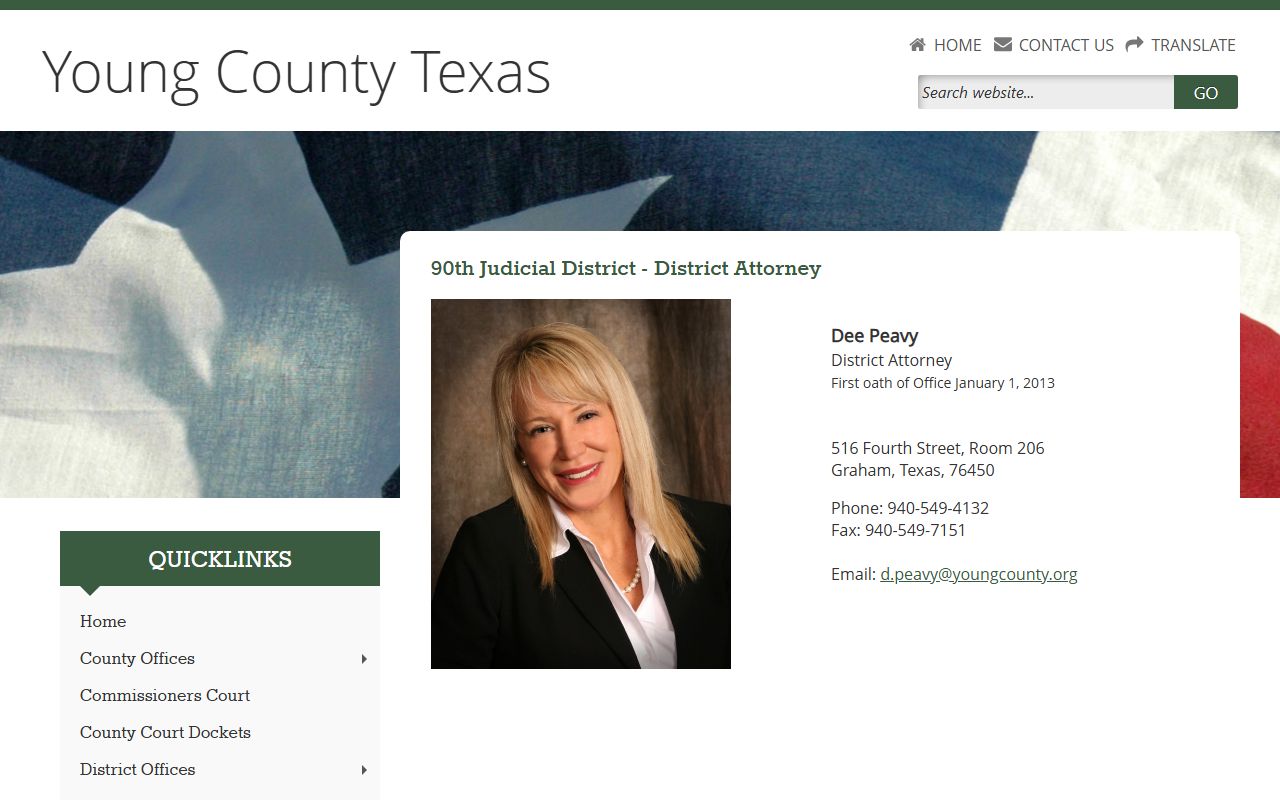
The prosecutor contact is important because a jail charge may not become a formal court charge until prosecutorial review or grand-jury action occurs.
Find Young County Arrest Court Records
The best search sequence starts with the jail roster, then splits by case type. Capture the defendant name, arrest number, booking date, and charge text from the Young County NetData roster. That information helps the clerk or portal distinguish one person from another and helps identify whether a matter is felony, county misdemeanor, municipal Class C, warrant-based, or still pending review.
- Check the Young County current jail list for the booking date, short charge, and arrest number.
- Search re:SearchTX for statewide case information, hearings, and available documents.
- Check the District Court docket calendar for felony or district settings.
- Check the County Court docket calendar for county criminal settings.
- Contact the District Clerk for district criminal filings and the County Clerk or County Court route for misdemeanor case records.
- Use Texas DPS Criminal History Conviction Name Search for statewide conviction-history checks that require an account and credits.
Source image: re:SearchTX is the statewide Texas court-record portal described as covering all 254 counties.
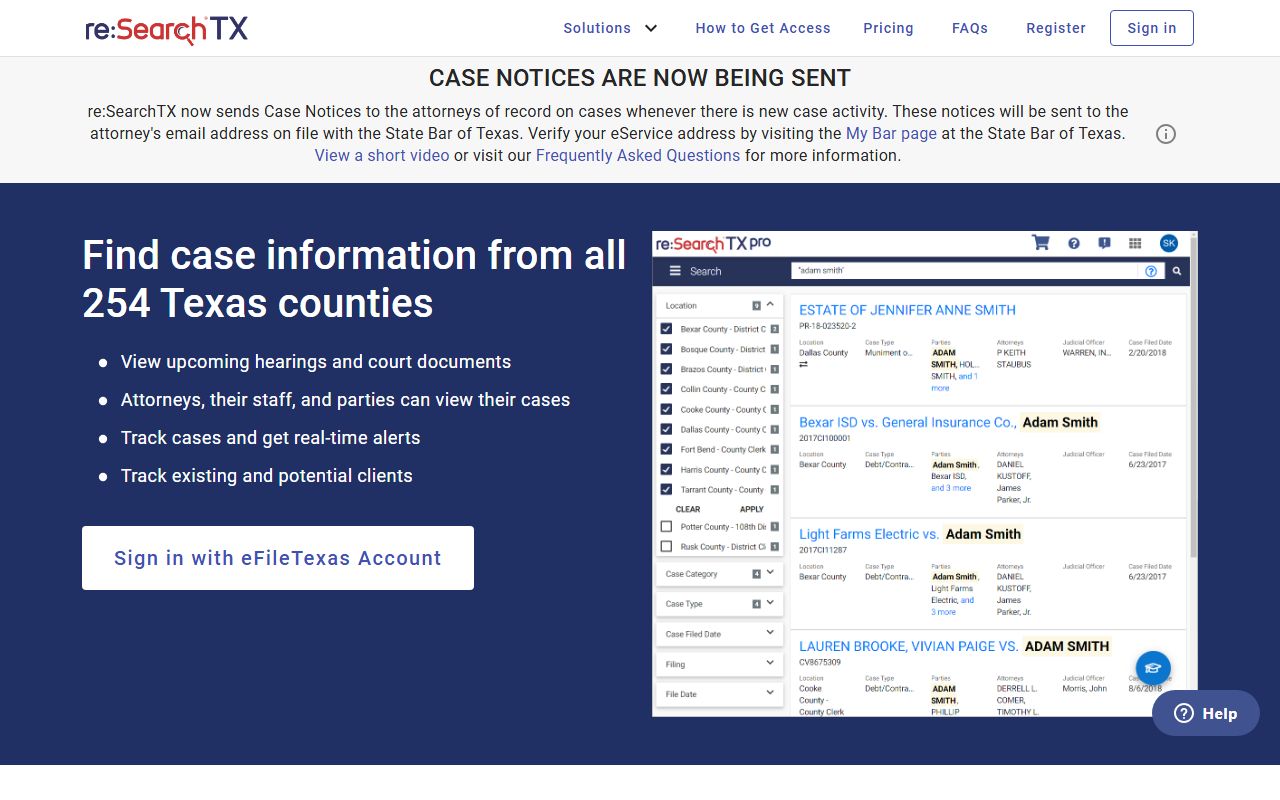
re:SearchTX is not the county jail roster. It is the court-record channel to check once the arrest has moved into a filed case or scheduled hearing.
Young County Court Record Routing
Young County court records after a jail arrest depend on the court level. Felony matters usually involve district court and the District Attorney. County Court handles many misdemeanor criminal matters. The county states that its constitutional County Court has exclusive original jurisdiction over misdemeanors with fines greater than $500 or jail sentences up to one year, and criminal cases are normally heard on Wednesdays. Municipal Class C cases from Graham route through Graham Municipal Court, not the county jail roster.
| Office or court | Use for | Contact facts |
|---|---|---|
| 90th Judicial District Attorney | Felony prosecution and charging decisions | Dee Peavy, 516 Fourth Street Room 206, 940-549-4132 |
| District Clerk | District criminal and civil court records | Stacey Beller Mallory, 516 Fourth Street, 940-549-0029 |
| County Court criminal | Misdemeanors within county court jurisdiction | Wednesday criminal settings; Timi Hall listed for pending-setting contact |
| County Clerk | County-level public records and clerk routing | Tina Gilliam, Room 104, 940-549-8432 |
| Graham Municipal Court | Class C municipal cases | 456 Oak, Graham, Judge James Reeves, 940.549.8370 |
Charges Filed After Arrest
After an arrest, the jail may enter an intake charge before a prosecutor has filed a final charging instrument. Court records after a Young County arrest may start with a sworn complaint, proceed by information, or move through indictment. The names of these documents matter because they tell the reader who made the accusation and which court path may follow.
| Charging document | Who creates it | What it means |
|---|---|---|
| Complaint | Officer, complainant, or prosecutor route | A sworn charging allegation or lower-court charging instrument. |
| Information | Prosecutor | A formal prosecutor-filed charge, often used in non-indicted cases. |
| Indictment | Grand jury | A grand-jury charging document, commonly associated with felony prosecution. |
Texas Code of Criminal Procedure Chapter 66 describes criminal justice information reporting for arrest, prosecution, disposition, sentencing, and correctional handling data. It helps explain why booking records, court filings, and statewide criminal-history records are related but not identical.
Young County Charge Status
Charge status changes as a case moves. A pending Young County court record means the case or count has not been resolved. Filed means the charge exists in a formal court record. Amended or reduced means the charge language or level changed. Dismissed means the count or case ended without conviction. Deferred adjudication is a Texas disposition where judgment may be deferred if court conditions are met.
| Status | What it means |
|---|---|
| Pending | The case or count is open and unresolved. |
| Filed | A formal charge has been created in court records. |
| Amended | The charge language changed after filing. |
| Reduced | The charge moved to a lower offense, level, or degree. |
| Dismissed | The case or count ended without a conviction on that charge. |
| Conviction | A guilty plea or finding produced a final court result. |
| Deferred adjudication | Texas disposition that may avoid final conviction if conditions are completed. |
Bond and Warrants After Arrest
Young County did not publish a full jail bond-payment guide in the inspected pages, and the public jail roster did not show bond amounts. Bond may be set by a magistrate, court, or schedule depending on offense and stage. Confirm bond with the jail, court, attorney, or licensed bondsman before acting. A hold can block release even when a local charge has bond.
| Bond or hold | How it affects court records after arrest |
|---|---|
| Cash bond | Full amount deposited when accepted by the proper authority. |
| Surety bond | A licensed bail bond company posts bond for fee or collateral. |
| Personal or PR bond | Release on promise and conditions after judicial approval. |
| No-bond hold | No release until a judge or holding authority acts. |
| Detainer | Another agency, including immigration or parole, may affect release. |
No official Young County sheriff active-warrant search page was located. Warrant questions route through the sheriff's office at 940-549-1555, the issuing court, Graham Municipal Court for city Class C matters, or a written public-information request when an existing public record is sought. A docket calendar is not a warrant-clearance tool.
Charges, Convictions, Sealed Records
A charge is an accusation. A conviction is a final result after a guilty plea or finding. This difference is central to Young County court records after a jail arrest because the jail row may appear before a prosecutor files, before the court rules, or before all counts are resolved.
| Point | Charge | Conviction |
|---|---|---|
| Stage | Accusation or filed count | Final guilty plea or finding |
| Proof | Not proof of guilt | Court result after legal process |
| Where found | Jail roster, prosecutor file, court docket | Court record and DPS conviction-history channel when reportable |
Sealing and expunction are also distinct. Texas law can restrict public access to eligible records through court orders, but the result depends on the disposition and the exact relief granted. Texas Government Code Chapter 552 still governs public-information requests, while exceptions, nondisclosure, expunction, juvenile limits, and law-enforcement rules may restrict access.
| Point | Sealed or nondisclosed | Expunged |
|---|---|---|
| Public access | Hidden from many public searches by court order | Treated as removed from public record under the order |
| Agency access | Some government or justice access may remain | Access is more limited and controlled by the expunction order |
| Typical route | Court petition and eligibility review | Court petition after eligible dismissal, acquittal, or other qualifying result |
DPS and Restricted Records
The DPS Criminal History Conviction Name Search instructions state that users need a CRD secure website account and search credits. That system is a statewide criminal-history and conviction channel, not the Young County jail roster and not a full substitute for local court files. It can help when the question is whether a reportable conviction exists rather than whether someone was booked into Young County Jail last night.
Source image: the Texas DPS Criminal History Conviction Name Search page is the statewide conviction-search channel cited in the research.
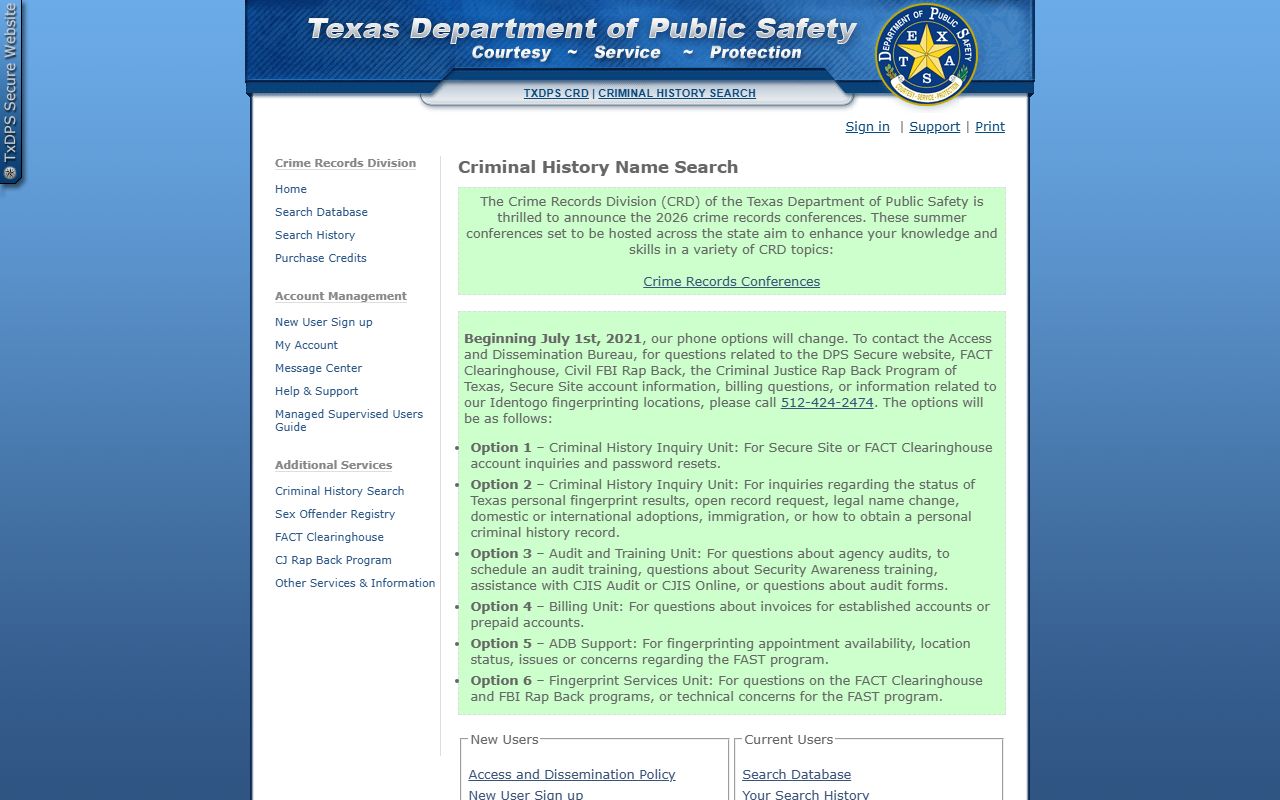
DPS records and local court records should be read together only when the search purpose calls for both a local case path and a statewide conviction-history check.
Important: Public lookup material that is not a consumer report must not be used for FCRA-covered screening.